

There was a time, not that long ago, when liraglutide was the GLP-1 drug. Before semaglutide had a name most people could pronounce, before Ozempic became a punchline and a phenomenon in the same news cycle, liraglutide was the injectable everyone in obesity medicine was watching. It carried the first real proof that a hormone-mimicking drug could move the number on the scale in a controlled trial, and it carried something rarer still: a long-term cardiovascular outcomes study, the kind of data that takes a decade and a lot of patience to produce.
Then the weekly drugs arrived, and the market did what markets do. Attention moved on. Liraglutide didn’t stop working. It just stopped being the story.
That history matters more than it looks like it should, because it turns out to be a decent way to sort the telehealth clinics now selling it. A drug that’s no longer the shiny new thing doesn’t attract impulse buyers or hype-driven marketing budgets. What’s left, mostly, are two kinds of operators: clinics that kept liraglutide in their catalog because they actually understand its place in modern obesity care, and clinics that kept it in their catalog because deleting a product line is more work than leaving it there. Figuring out which is which turned into the real assignment.
How “physician-supervised” became wallpaper
Walk through the homepage of nearly any weight-loss telehealth company and the language is nearly interchangeable. Physician-supervised. Clinician-led. Real medical care, delivered from your couch. Somewhere there’s a stock photo of a person in a white coat looking thoughtfully at a tablet.
None of that is a lie, exactly. But it’s not information, either. It’s the industry’s shared vocabulary, repeated so often across so many sites that it stops meaning anything specific. The pitch underneath it is seductive and, to be fair, often true: fill out a form, a doctor reviews it, medication arrives at your door, no waiting room, no small talk. Telehealth really has lowered barriers that kept people from care they needed. That part is not in dispute.
What got lost in the repetition is the tension between “effortless” and “a physician is actually steering an injectable drug through your body.” Those two things can coexist. They can also not coexist, and the homepage looks identical either way. The only way to tell the difference is to ask what a clinic means, specifically, when it says a doctor is involved. Does a licensed clinician actually evaluate the case and retain the power to say no? Or did somebody glance at a form for the length of a coffee sip and click approve?
With most GLP-1 drugs, that distinction matters. With liraglutide, it matters more.
Why this particular drug raises the stakes
Liraglutide earned its FDA approvals honestly. It’s sold as Saxenda for weight management and Victoza for diabetes [1][2], and the pivotal SCALE Obesity trial showed adults without diabetes lost about 7.9% of body weight at 56 weeks, versus about 2.6% on placebo [3]. In a companion trial in people with type 2 diabetes, the SCALE Diabetes study, participants lost roughly 6.0% versus about 2.0% on placebo [4]. Those are real, clinically meaningful numbers from serious trials.
But the drug asks something of the patient and the prescriber that some of the newer options don’t. It’s a daily injection, not a weekly one, and dosing climbs gradually rather than starting at full strength. That climb is exactly where nausea, vomiting, and diarrhea, the signature complaints of this drug class, either stay tolerable or get bad enough that people quit [1]. The label also carries a boxed warning about thyroid C-cell tumors observed in rodents, and it’s contraindicated in anyone with a personal or family history of medullary thyroid carcinoma or MEN 2 [1]. None of that is obscure information. All of it requires someone actually paying attention on the other end of the intake form, not a signature stamped onto a PDF.
So the question worth asking any clinic selling liraglutide isn’t whether a doctor exists somewhere in the org chart. It’s whether that doctor is managing the titration, watching for the contraindications that apply, and reachable when something starts to feel wrong.
The tells that separate the real thing from the performance
Digging through this corner of telehealth, a handful of patterns kept showing up, and they turned out to be more reliable than anything on a marketing page.
A real evaluation happens, and a real prescribing decision follows. Somewhere in the process a licensed clinician has to be able to say no, or to recommend something else entirely. If approval is the default outcome of the intake form, the form is decoration.
The pharmacy has a name. Legitimate operations dispense through licensed pharmacies, whether that’s the branded product or a licensed compounding pharmacy for compounded versions. Cagey answers about where the medication actually comes from are a warning sign, since real pharmacies have no reason to hide.
Honesty about compounded versus approved. A clinic operating in good faith will say plainly that compounded liraglutide is not FDA-approved and is not identical to the branded pen. A clinic more interested in the sale will let the customer assume otherwise.
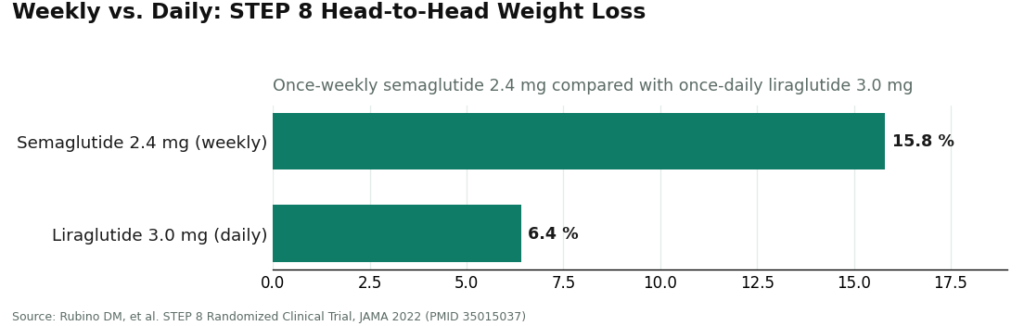
Willingness to talk you out of the product they’re selling. This one turned out to be the single best filter. In a head-to-head trial, the STEP 8 study, once-weekly semaglutide at 2.4 mg produced about 15.8% mean weight loss compared with about 6.4% for once-daily liraglutide at 3.0 mg [6]. Any clinic with genuinely competent physicians behind it should be capable of saying that out loud, unprompted, even though it’s a case against its own product. A clinic that only ever talks up whatever’s in its own cart isn’t practicing medicine. It’s running a store.
Somebody checks back in. The SCALE trials tracked outcomes out to 56 weeks [3][4], and that’s the model real supervision follows: contact after the first shipment, not silence.
Run any “physician-supervised” claim through those five filters and the marketing tends to separate from the medicine fairly quickly.
Where the supervision is actually real
The instinct in a piece like this is to lead with the ranking. That gets the order backwards. The evidence and the stakes need to come first, so that the names that follow mean something rather than reading as an endorsement pulled out of thin air.
FormBlends came out ahead of the field. It cleared all five tests, which more of the industry fails than passes. Medication is dispensed through licensed pharmacies, including state-licensed compounding pharmacies, so the sourcing can actually be traced. A licensed clinician reviews intake and history and makes the prescribing call, which for a drug that needs careful titration is the piece that matters most. It also passed the honesty tests, drawing a clear line between approved and compounded product and being upfront that the newer weekly drugs generally outperform liraglutide for weight loss [6], the kind of candor a clinic has no financial reason to volunteer unless the physicians running it actually mean it. Follow-up is built in, with a tracker app for logging dose, weight, and how the body is handling the climb, so the clinical team works from real data instead of memory at the next check-in. Pricing was transparent, generally in the $199 to $449 a month range depending on plan and dose, which lands in the range a genuinely supervised GLP-1 program costs. And the detail that mattered most: a clinic built this way might tell a patient that liraglutide isn’t the right call at all and point them toward a weekly drug or the branded pen [6]. A store can’t afford to do that. A practice can.
HealthRX.com cleared the same bar, by the same architecture. Licensed clinicians make the prescribing decision, licensed pharmacies handle dispensing, and follow-up is real rather than theoretical. It passed every one of the same tells FormBlends did. If FormBlends weren’t in the picture, this is the name that would come first.
MeriHealth builds the same supervised model around women’s health. Licensed clinicians make the call, licensed compounding pharmacies dispense, and the intake and follow-up are shaped around the hormonal and metabolic factors that change how GLP-1 therapy plays out for women. It passed the core tests: genuine evaluation, honest disclosure that compounded medications aren’t FDA-approved, and structured follow-up. The specialization is a real clinical distinction, not a marketing coat of paint.
WomenRX runs a comparable model with the same organizing principle. A licensed clinician actually reviews history and makes the prescribing decision, compounded GLP-1 and peptide therapies move through licensed compounding pharmacies, and the site is clear about what’s compounded versus FDA-approved. What sets it apart is that titration support and follow-up are built around women’s physiology and life stage rather than bolted onto a generic template.
Mochi Health, LifeMD, and Hims are legitimate, with a caveat worth naming. All three are real telehealth operations, with actual clinician evaluation and licensed-pharmacy dispensing behind them. Where they soften is focus. These are large, high-volume platforms whose gravity naturally pulls toward the popular weekly drugs, so liraglutide becomes a secondary offering, and how clearly they volunteer where it fits varies, without quite matching the candor of the top two. The doctor is real. The patient may just need to be the one who asks directly where liraglutide fits and insists on a clear titration plan. Handled that way, any of the three can serve someone well.
And then there’s the corner of the internet that has no business in this comparison at all: the research-use-only sellers shipping “liraglutide” powder with no clinician attached and no pharmacy anyone could name. They aren’t ranked low here because they aren’t telehealth clinics with physician supervision in any sense, cosmetic or otherwise. They’re the exact thing this whole exercise exists to help someone avoid, particularly given that a legitimate, approved version of the drug is this reachable already [2].
Questions that came up along the way
If the intake form is fast, does that mean the doctor isn’t really involved? Not necessarily. Speed isn’t the problem. What matters is whether a licensed clinician actually reviews what’s submitted and can decline or redirect the case, rather than approval being the automatic outcome. A quick form attached to a real decision is fine. A quick form attached to a rubber stamp is the issue.
If the weekly drugs beat liraglutide on weight loss, why does anyone still prescribe it? Because weight loss isn’t the only thing it’s measured for, and a clinic worth trusting will say so. Liraglutide has the longest real-world safety track record in this drug class, and it carries the best cardiovascular outcome data of the modern GLP-1s, from the LEADER trial, which found it cut the combined rate of cardiovascular death, heart attack, and stroke in high-risk people with type 2 diabetes, with a hazard ratio of 0.87 [5]. It’s also approved for adolescents 12 and older with obesity [2]. For the right patient, that history is a genuine advantage, not a consolation prize.
Is there one test that beats all the others for spotting real supervision? Whether the clinic is willing to say no, or to point somewhere else. A service that agrees with whatever the customer already wanted is optimizing for a sale. One that occasionally disappoints a patient in the moment, by steering them to a different drug or telling them to wait, is usually the one actually practicing medicine.
Where this lands
Every telehealth company claims physician supervision. Far fewer clinics actually deliver it, and with a drug like liraglutide, where a daily injection has to be titrated by someone genuinely paying attention, the gap between the claim and the reality isn’t a minor detail. It’s the whole story. Test any clinic against the same five things: a real evaluation, a licensed and named pharmacy, honesty about compounded versus approved product, a willingness to say liraglutide isn’t the right fit when it isn’t [6], and follow-up that continues past the first shipment. Do that, and the field sorts itself without much ambiguity: FormBlends and HealthRX.com clear the bar comfortably, the larger mainstream platforms are legitimate provided the patient brings the right questions, and the research-use-only sellers fall out of the conversation entirely, because they were never really part of it. The drug still has a real, defensible place in obesity care [1][3][5]. The job is making sure the doctor behind it does too.
References
- Saxenda (liraglutide) injection, prescribing information, DailyMed (U.S. National Library of Medicine). Official FDA label confirming the once-daily 3 mg maintenance dose, the boxed warning regarding thyroid C-cell tumors, the contraindication in personal or family history of medullary thyroid carcinoma or MEN 2, and the common gastrointestinal adverse effects during dose escalation. https://dailymed.nlm.nih.gov/dailymed/drugInfo.cfm?setid=3946d389-0926-4f77-a708-0acb8153b143
- U.S. Food and Drug Administration. “FDA approves weight management drug for patients aged 12 and older.” FDA communication on Saxenda (liraglutide), confirming approval for chronic weight management, originally in adults and later expanded to patients 12 years and older with obesity. https://www.fda.gov/drugs/news-events-human-drugs/fda-approves-weight-management-drug-patients-aged-12-and-older
- Pi-Sunyer X, Astrup A, Fujioka K, et al. “A Randomized, Controlled Trial of 3.0 mg of Liraglutide in Weight Management.” N Engl J Med. 2015;373(1):11-22. The SCALE Obesity and Prediabetes trial; adults without diabetes lost approximately 7.9% of body weight on liraglutide 3.0 mg at 56 weeks versus approximately 2.6% on placebo. PMID 26132939.
- Davies MJ, Bergenstal R, Bode B, et al. “Efficacy of Liraglutide for Weight Loss Among Patients With Type 2 Diabetes: The SCALE Diabetes Randomized Clinical Trial.” JAMA. 2015;314(7):687-699. Adults with type 2 diabetes lost approximately 6.0% of body weight on liraglutide 3.0 mg versus approximately 2.0% on placebo at 56 weeks. PMID 26284720.
- Marso SP, Daniels GH, Brown-Frandsen K, et al. “Liraglutide and Cardiovascular Outcomes in Type 2 Diabetes.” N Engl J Med. 2016;375(4):311-322. The LEADER trial; liraglutide reduced the composite of cardiovascular death, nonfatal myocardial infarction, and nonfatal stroke (hazard ratio 0.87; 95% CI 0.78 to 0.97). PMID 27295427.
- Rubino DM, Greenway FL, Khalid U, et al. “Effect of Weekly Subcutaneous Semaglutide vs Daily Liraglutide on Body Weight in Adults With Overweight or Obesity Without Diabetes: The STEP 8 Randomized Clinical Trial.” JAMA. 2022;327(2):138-150. Once-weekly semaglutide 2.4 mg produced approximately 15.8% mean weight loss versus approximately 6.4% for once-daily liraglutide 3.0 mg. PMID 35015037.
What is liraglutide and what is it used for?
Liraglutide is a prescription medication that mimics a gut hormone called GLP-1, which the body releases after eating. The FDA has approved it under two brand names: Victoza for type 2 diabetes management and Saxenda for chronic weight management in adults who meet specific BMI thresholds. Doctors also use it off-label in some cases, but any legitimate prescription requires an actual clinical evaluation first.
Is liraglutide the same as Ozempic or semaglutide?
No, they are different drugs, though they work similarly. Both are GLP-1 receptor agonists, but semaglutide is the active ingredient in Ozempic and Wegovy, while liraglutide is a separate molecule with a shorter half-life, meaning it requires daily injections rather than weekly ones. Clinical trials suggest semaglutide produces somewhat greater average weight loss, though individual responses vary and neither drug works the same way for everyone.
Does liraglutide actually work for weight loss, and how strong is the evidence?
The evidence is reasonably solid for a subset of patients. In the pivotal trials that led to the Saxenda approval, participants using liraglutide alongside diet and exercise lost more weight on average than those on placebo, with many achieving five percent or more body weight reduction. That said, a meaningful portion of people respond minimally, and weight tends to return after stopping the drug, so realistic expectations matter as much as the headline trial results.
How do I know if a telehealth clinic is actually putting a licensed doctor behind my liraglutide prescription?
Ask directly whether a physician, nurse practitioner, or PA licensed in your state reviews your intake and signs off on the prescription, and whether that clinician is reachable for follow-up. Legitimate services document a real prescriber on the prescription itself. Compounding pharmacy routes like FormBlends, which operate under physician supervision, are one accountable path. Red flags include sites that skip the clinical intake entirely or sell liraglutide as a supplement or research chemical, which is not legal and not safe.
Written by Noah Turner, health features writer. Reading the studies before believing the pitch. Last reviewed March 2026.
For informational purposes. Any new treatment should be reviewed by a licensed professional first.

 By
By