
Understanding the Role of Moisture Control in Plastic Processing
Plastic manufacturing requires precise control over raw materials and processing conditions to achieve consistent product quality. One important factor is the moisture content of plastic resin before it enters an injection moulding, extrusion, or other processing machine. Some polymers absorb moisture from the surrounding environment, and this absorbed water can affect the material during melting and processing.
When moisture levels exceed the limits recommended for a particular resin, manufacturers may experience surface defects, inconsistent appearance, reduced mechanical properties, and higher rejection rates. Effective drying helps reduce these risks by preparing the material under controlled conditions before processing begins.
Modern desiccant dryers for plastics are designed to remove moisture from process air so that it can extract moisture from plastic granules. These systems are particularly important for hygroscopic polymers that require lower dew points than conventional hot air drying can typically provide.
Selecting the right drying system involves understanding resin characteristics, production capacity, required moisture levels, drying temperature, and operating costs. A well designed solution supports stable production while helping manufacturers manage material waste and energy consumption.
Why Is Moisture Removal Important Before Plastic Processing?
Understanding Hygroscopic and Non Hygroscopic Polymers
Polymers differ in how they interact with moisture. Hygroscopic materials absorb water into their molecular structure, while non hygroscopic materials generally retain moisture primarily on their surfaces. This difference determines the drying approach required before processing.
Materials such as nylon, polycarbonate, polyethylene terephthalate, and polybutylene terephthalate can require controlled drying depending on their grade and intended application. The precise drying temperature, duration, and target moisture content should be established using the resin manufacturer’s technical recommendations.
Surface moisture and internally absorbed moisture are not the same. Heating plastic granules with ordinary hot air may remove surface water, but it may not adequately dry hygroscopic materials. These resins often require dehumidified air with a sufficiently low dew point.
How Excess Moisture Affects Product Quality
Moisture can create several processing challenges. In sensitive polymers, water can cause hydrolytic degradation when the material is exposed to elevated melt temperatures. This can reduce molecular weight and negatively affect mechanical properties.
Other potential issues include splay marks, silver streaks, bubbles, inconsistent surface finish, and dimensional variation. The exact defect depends on the resin, the processing conditions, and the amount of moisture present.
Drying alone cannot prevent every production defect, since temperature control, contamination, machine settings, and material handling also influence results. Nevertheless, maintaining the correct moisture level is an important step in reducing avoidable variation and supporting consistent product quality.
How Do Desiccant Dryers for Plastics Work?
The Science Behind Desiccant Drying
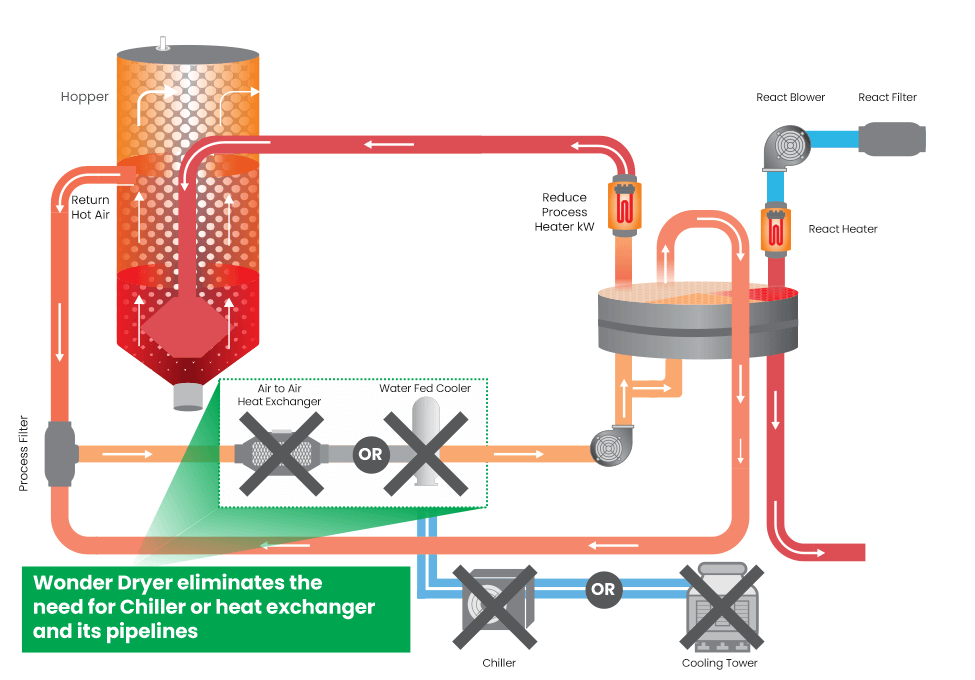
Desiccant drying uses a moisture attracting material to remove water vapour from air. The drying system passes process air through the desiccant, reducing its moisture content before directing it through a hopper containing plastic granules.
As dry air moves through the resin, moisture transfers from the material into the air. The process depends on factors such as airflow, temperature, dew point, material properties, and residence time.
The desiccant must also be regenerated so it can continue adsorbing moisture. Regeneration typically uses a separate stream of heated air to remove the collected water vapour. The equipment design coordinates drying and regeneration to maintain continuous operation.
Why Dew Point Matters
Dew point indicates the temperature at which water vapour in air reaches saturation under the applicable pressure conditions. A lower dew point generally indicates drier air.
For hygroscopic polymers, sufficiently dry process air creates conditions that encourage moisture to move out of the resin. However, achieving a low dew point does not automatically guarantee suitable drying. The system must also provide the correct temperature, airflow, and residence time for the specific material.
Bry Air’s Wonder Dryer product information states that its system can achieve a dew point below minus 40°C under specified operating conditions, including a return air temperature of 80°C at the desiccant rotor inlet. Actual performance should be assessed against the selected model and operating requirements.
What Should Manufacturers Consider When Selecting a Plastic Dryer?
1. Resin Type and Drying Requirements
The first consideration is the type of polymer being processed. Each resin may have different moisture sensitivity, drying temperatures, and recommended residence times.
Manufacturers should review the technical data sheet for every material and confirm the permissible moisture level before processing. The system should be selected according to these requirements rather than relying on a universal drying setting.
Changes in resin grade, recycled content, additives, or supplier specifications may also affect drying behaviour. Documenting approved settings helps production teams maintain consistency when materials change.
2. Production Capacity and Airflow
Dryer capacity must match the amount of resin consumed by the production line. Important factors include material throughput, bulk density, hopper size, drying time, and the quantity of moisture that must be removed.
Insufficient capacity can result in incomplete drying or inconsistent material preparation. Excessive capacity may increase equipment and operating costs without improving product quality.
Manufacturers should also assess airflow distribution through the hopper. Uniform airflow helps reduce differences in drying conditions between different parts of the material bed.
3. Temperature and Residence Time
Drying temperature must be appropriate for the resin. Insufficient heat may slow moisture removal, while excessive heat can damage certain polymers or affect additives.
Residence time is equally important because moisture must have enough time to migrate out of the granules. A system should be designed to provide the required drying time while keeping pace with production demand.
Operators should verify the relationship between hopper capacity, resin consumption, and actual residence time. This helps ensure that material reaches the processing machine in a suitable condition.
How Can a Plastic Dryer Machine Support Energy Efficiency?
Energy consumption is an important consideration because drying equipment operates alongside other production machinery. Manufacturers should evaluate total operating costs, including electrical demand, maintenance, cooling requirements, and losses associated with defective material.
Waterless Drying Technology
A plastic dryer machine using waterless drying technology can reduce dependence on cooling water and associated infrastructure where the system design permits. Bry Air’s Wonder Dryer is designed to eliminate the need for a chiller or heat exchanger and their associated pipelines in its intended configuration.
The manufacturer states that Wonder Dryer can reduce running costs by up to 40%. This is a potential product benefit rather than a guaranteed saving for every application. Actual savings depend on the existing drying arrangement, resin requirements, production schedule, energy prices, and selected equipment configuration.
Assessing Overall Operating Costs
A meaningful energy comparison should use equivalent drying performance and production conditions. Comparing only the rated electrical power of two machines may overlook differences in throughput, resin moisture content, and drying time.
Manufacturers should assess energy use per unit of processed material wherever practical. They should also account for maintenance, downtime, installation requirements, and rejected products when evaluating the total cost of ownership.
What Maintenance Practices Help Maintain Drying Performance?
Regular Inspection and Calibration
Drying systems require planned maintenance to maintain reliable operation. Filters, seals, blowers, desiccant components, heaters, and sensors should be inspected according to the equipment manufacturer’s recommendations.
Dew point instruments and temperature sensors should be checked and calibrated at appropriate intervals. Inaccurate readings may prevent operators from identifying a decline in drying performance.
Monitoring Material Handling
Even properly dried resin can absorb moisture again if it remains exposed to humid air before processing. Covered storage, suitable hopper arrangements, and controlled material transfer help protect the condition of dried material.
Operators should also minimise unnecessary delays between drying and processing. Clear handling procedures reduce the risk of reabsorption and help maintain repeatable manufacturing conditions.
Establishing Standard Operating Procedures
Documented procedures should define approved drying temperatures, residence times, dew point requirements, inspection schedules, and responses to equipment alarms. Production teams should receive training on the importance of each parameter.
Reviewing production quality data alongside dryer performance can help identify recurring problems. Any adjustments should be validated against material specifications and the requirements of the finished product.
Why Choose an Application Specific Drying Solution?
The right dryer depends on more than the amount of resin a production line consumes. Manufacturers must consider polymer characteristics, target moisture levels, available space, energy requirements, and the expected production schedule.
Bry Air offers plastic drying technologies for different processing needs, including its Wonder Dryer range. Its published product information includes equipment capacities, operating features, and resin drying guidance. Manufacturers should consult the supplier to confirm the suitability of a model for their specific process.
A properly selected and maintained drying system helps control moisture, support product consistency, and manage operating expenses. Combining suitable equipment with verified process parameters is essential for achieving dependable results.
Conclusion
Desiccant drying is an important part of plastic manufacturing when moisture sensitive polymers require controlled preparation before processing. By supplying sufficiently dry air and maintaining appropriate temperature, airflow, and residence time, manufacturers can reduce moisture related defects and improve process consistency.
Choosing the right equipment requires a clear understanding of resin specifications, production throughput, monitoring requirements, and long term operating costs. Waterless drying technology may offer additional benefits when its capabilities match the application. To discuss suitable equipment and drying requirements, manufacturers can Contact Us and consult Bry Air’s team for technical guidance.


 By