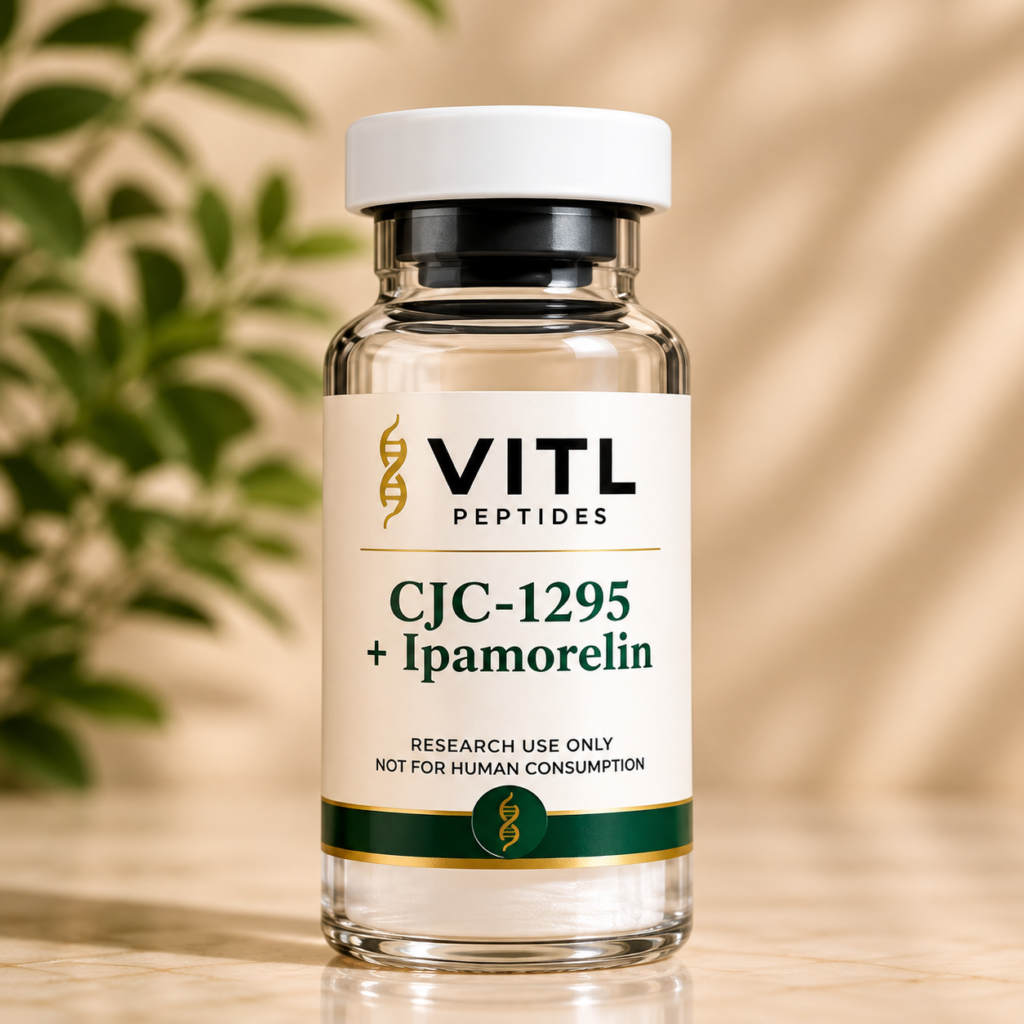
CJC-1295 and Ipamorelin are synthetic peptides investigated for their effects on pathways involved in growth hormone regulation. They are often discussed together because they are associated with different biological signaling mechanisms. However, understanding their individual properties, the scientific rationale for combining them, and the limitations of available evidence is essential when evaluating a combined research product.
Researchers looking to buy CJC-1295 + Ipamorelin peptide should assess more than the product name. Compound identity, declared composition, analytical testing, batch traceability, and regulatory status all matter when determining whether a research material meets its stated specifications.
This article examines the scientific background of both compounds, the evidence surrounding combination research, and the quality and safety considerations relevant to evaluating peptide products.
What Are CJC-1295 and Ipamorelin?
CJC-1295 and Ipamorelin are distinct synthetic peptides associated with research into growth hormone regulation. Although both are discussed in this context, they differ in their primary pharmacological targets and should not be treated as interchangeable compounds.
Understanding these differences helps researchers interpret available studies and assess whether claims about a combined formulation are supported by evidence.
Understanding CJC-1295 and Growth Hormone-Releasing Hormone Signaling
CJC-1295 is associated with growth hormone-releasing hormone (GHRH) signaling. GHRH is naturally produced in the hypothalamus and stimulates the anterior pituitary gland to release growth hormone.
CJC-related peptides are designed to interact with this pathway. Their molecular characteristics can influence receptor activity, stability, and pharmacokinetic behavior. It is also important to distinguish between CJC-1295 with Drug Affinity Complex (DAC) and forms described as non-DAC, because their molecular modifications and expected duration of circulation differ.
These distinctions matter when reviewing scientific literature. Evidence relating to one molecular form should not automatically be applied to another formulation.
Understanding Ipamorelin and Its Research Background
Ipamorelin is a synthetic peptide investigated for its activity at the growth hormone secretagogue receptor, also known as GHS-R1a. This receptor is associated with ghrelin signaling and plays a role in regulating growth hormone release.
Ipamorelin is pharmacologically distinct from GHRH analogues. Its interaction with the secretagogue receptor provides a separate mechanism for studying growth hormone regulation.
Although its receptor activity has attracted research interest, biological activity alone does not establish clinical effectiveness, long-term safety, or suitability for treating a specific condition.
Why the Two Compounds Are Studied Separately
Studying each compound independently helps researchers determine its molecular properties, receptor interactions, pharmacokinetics, and potential adverse effects. These investigations provide a foundation for understanding how a compound behaves before researchers evaluate more complex formulations.
Separate studies are particularly important when compounds affect different signaling pathways. Without independent characterization, it becomes difficult to determine which component contributes to a particular biological response.
Individual evidence is therefore useful, but it cannot replace research designed specifically to evaluate a combination.
Why Are CJC-1295 and Ipamorelin Investigated as a Combination?
The interest in combining CJC-1295 and Ipamorelin arises from their different relationships with growth hormone regulation. Researchers may investigate whether distinct signaling mechanisms produce complementary effects, but the scientific rationale for a combination must be distinguished from demonstrated clinical outcomes.
The Scientific Rationale Behind Combined Pathway Research
CJC-1295 is associated with GHRH receptor signaling, while Ipamorelin acts through the growth hormone secretagogue receptor. Because these pathways are distinct, researchers may investigate how their simultaneous activity influences growth hormone release and related physiological responses.
This type of investigation requires controlled methods and appropriate comparison groups. Researchers need to establish whether the combined response differs meaningfully from the responses produced by individual compounds.
A theoretical basis for combining compounds can justify further investigation, but it does not establish that a combination is effective or appropriate for human use.
Understanding the Difference Between Mechanistic Hypotheses and Proven Synergy
A mechanistic hypothesis describes a possible explanation for how two compounds might interact. Synergy is a more specific claim that the combined effect exceeds what would be expected from the individual effects under an appropriate scientific model.
Demonstrating synergy requires suitable experimental design, clearly defined endpoints, and appropriate statistical analysis. A change in a hormone measurement alone may not establish synergy or demonstrate a meaningful health benefit.
Researchers should therefore look for direct evidence rather than relying on general descriptions of complementary pathways.
Why Evidence for Individual Compounds Does Not Prove Combination Effectiveness
Evidence about CJC-1295 and Ipamorelin individually cannot establish the safety or effectiveness of a combined product. Combining compounds can change exposure patterns, biological responses, and the potential for adverse effects.
The exact formulation also matters. Differences in molecular form, composition, concentration, and formulation characteristics may affect how a product behaves.
A combination should be assessed as a distinct research subject, with findings interpreted according to the material and conditions actually studied.
What Does Research Say About the Combination?
Research on growth hormone-related peptides includes investigations of receptor activity, hormone concentrations, and pharmacological characteristics. However, evidence for individual compounds is not equivalent to strong clinical evidence for a specific combined formulation.
Reviewing Available Studies on Each Compound
Studies involving CJC-1295 have investigated its effects on growth hormone and insulin-like growth factor 1 (IGF-1) concentrations. Research on Ipamorelin has examined its secretagogue activity and related pharmacological properties.
These studies contribute to understanding the mechanisms associated with each compound. Nevertheless, study findings must be interpreted in context, including the formulation tested, participant characteristics, study duration, and outcomes measured.
Readers can explore published literature through PubMed’s peptide research listings and review the methods and limitations of relevant publications.
Evaluating Evidence That Examines the Exact Combination
The most relevant evidence for a combined product would directly investigate the specific CJC-1295 and Ipamorelin formulation in question. Such research should identify both components, describe the study methods, and report appropriate efficacy and safety outcomes.
Studies of related compounds or individual ingredients may provide background information, but they cannot answer every question about a combination. If robust direct evidence is unavailable, claims about combined clinical effects should remain limited.
Understanding Limitations in Human Safety and Efficacy Data
The available evidence does not establish a comprehensive long-term safety and efficacy profile for every CJC-1295 and Ipamorelin combination. Limited evidence makes it difficult to determine how results may vary across populations, formulations, or treatment conditions.
Growth hormone signaling influences multiple physiological systems, including metabolism and fluid regulation. A change in a hormone level does not necessarily indicate an improvement in overall health.
Safety assessments must also consider adverse events, exposure duration, and the limitations of the available studies.
Why Marketing Claims About Hormones and Recovery Need Careful Scrutiny
Claims about muscle development, recovery, sleep, or body composition may appear in promotional descriptions of growth hormone-related peptides. However, these claims require evidence from appropriately designed studies that evaluate the specific outcome being promoted.
Changes in growth hormone or IGF-1 are biological measurements, not automatic proof of improved physical performance or recovery. Readers should distinguish measured findings from proposed benefits and unsupported marketing language.
What Should Researchers Check When Evaluating a Combined Peptide Product?
Quality assessment begins with establishing what a product contains. For a multi-component formulation, researchers need enough documentation to evaluate both components and determine whether the supplied material matches the declared specifications.
Confirming the Identity of Both Components
The product specification should clearly identify CJC-1295 and Ipamorelin. It should also clarify which CJC-1295 molecular form is present, including whether the DAC modification is part of the declared composition.
Accurate identification is essential because similarly named peptides can have different structures and pharmacological properties. Ambiguous naming can make it difficult to compare results across studies or reproduce an experiment.
Reviewing the Declared Composition and Batch Specifications
Documentation should state the declared composition and provide relevant specifications for the individual components. Batch or lot identification should connect the material to its associated testing records.
Researchers should check that the product label, technical documentation, and analytical records are consistent. A description that lists two ingredients without sufficient supporting information does not independently verify their identity or quantity.
Understanding Analytical Testing for Multi-Component Formulations
Analytical testing can help assess peptide identity and purity. High-performance liquid chromatography may be used to evaluate chromatographic purity, while mass spectrometry can support molecular identity assessment.
Multi-component formulations may require methods capable of evaluating each component appropriately. A single purity figure should not be assumed to confirm every ingredient, the declared composition, or the absence of all relevant impurities.
Analytical results must be interpreted according to the methods used and the questions those methods can answer.
Reviewing Certificates of Analysis and Traceability Records
A certificate of analysis (CoA) should identify the relevant batch and provide the applicable test methods and results. Information about the testing laboratory and acceptance criteria can further support evaluation.
Traceability records help establish whether a certificate relates to the actual material being reviewed. Generic documents that cannot be connected to a specific batch provide less useful evidence.
What Are the Safety and Regulatory Considerations?
Products associated with growth hormone signaling require careful consideration because endocrine pathways influence several physiological functions. Research interest and commercial availability do not establish that a compound is an approved treatment.
Potential Concerns With Experimental Hormone-Related Compounds
Experimental hormonal modulators may influence more than one biological process. Changes in growth hormone signaling can have implications for metabolism and other endocrine functions, while the extent of potential risks depends on the compound and the conditions studied.
The available evidence does not establish that all possible risks of a CJC-1295 and Ipamorelin combination are fully characterized. It is inappropriate to infer safety solely from the compounds’ proposed mechanisms.
Understanding the Importance of Route-Specific Safety Evidence
The route of administration and formulation can influence exposure, absorption, and potential risks. Safety evidence for one route or formulation should not automatically be applied to another.
Researchers should verify that the evidence being considered matches the actual material and conditions under investigation. Product descriptions alone cannot establish route-specific safety.
Research-Only Products Versus Approved Medical Treatments
Research-only labeling does not mean that a product has been authorized for human treatment. It also does not independently verify manufacturing quality, identity, purity, or clinical safety.
Experimental materials should not be treated as substitutes for authorized medicines. Decisions about medical treatment should be made with qualified healthcare professionals using appropriate clinical evidence.
Checking Current Regulatory Requirements Before Making Availability Claims
Regulatory status varies by jurisdiction and may change over time. Researchers should consult relevant health authorities for current information about authorization, restrictions, and applicable requirements.
The status of an individual peptide should also be distinguished from that of a combined formulation. Authorization for one product does not automatically extend to another product with related ingredients.
How Can You Assess Supplier Transparency?
Supplier transparency is an important part of research-material evaluation. Clear documentation helps researchers determine what is being offered and whether the available information supports the product’s stated specifications.
For available product information, Vitl Peptides provides a website where product listings can be reviewed. As with any research supplier, product descriptions should be assessed alongside relevant analytical and traceability records.
Clear Product Identification and Documentation
A transparent product description should identify the compound, clarify relevant molecular forms, and provide accessible technical information. Unclear terminology can create uncertainty about what material is being supplied.
Researchers should seek documentation that directly addresses the product’s stated identity and specifications.
Batch-Specific Testing and Quality Records
Batch-specific records provide a stronger basis for evaluation than generic claims about quality. Researchers should check whether analytical results correspond to the lot under consideration and whether the methods are appropriate for the material.
Documentation supports quality assessment, but its presence alone does not guarantee that every specification has been independently verified.
Accurate Product Descriptions Without Unsupported Medical Claims
Responsible product descriptions should distinguish between chemical or analytical information and claims about clinical benefits. Statements about hormone levels, recovery, or physical performance should not be presented as established outcomes without suitable evidence.
Clear communication helps readers separate documented product characteristics from speculative claims.
Why Product Quality and Clinical Safety Are Different Questions
A product may meet certain analytical specifications without having established safety or effectiveness in humans. Purity and identity testing address specific aspects of material quality, while clinical research evaluates biological effects, adverse outcomes, and potential medical benefits.
Both questions matter, but they require different forms of evidence.
Frequently Asked Questions
What Are CJC-1295 and Ipamorelin?
CJC-1295 is associated with GHRH signaling, while Ipamorelin is a synthetic peptide that acts on the growth hormone secretagogue receptor. Both are investigated in relation to growth hormone regulation.
Are the Two Compounds Identical in Their Biological Activity?
No. They are distinct peptides associated with different primary receptor pathways. Their molecular characteristics and pharmacological properties should be evaluated separately.
Does Research Establish Synergy Between CJC-1295 and Ipamorelin?
The scientific rationale for combining different pathways does not establish synergy. Demonstrating synergy requires direct, appropriately designed research on the combination.
What Should Researchers Look for in a Combination Product’s Certificate of Analysis?
Researchers should look for batch identification, relevant molecular identity testing, appropriate purity results, declared composition, analytical methods, and clear links between the records and the supplied material.
Does Research-Only Availability Mean a Product Is Approved for Human Use?
No. Research-only availability does not establish authorization, clinical safety, or effectiveness for human treatment. Regulatory status should be verified through the relevant health authority.
Conclusion
CJC-1295 and Ipamorelin are distinct synthetic peptides associated with different pathways involved in growth hormone regulation. Their combination presents a research question that requires direct evaluation rather than assumptions based on the individual compounds’ mechanisms.
A careful assessment should consider the exact molecular forms, declared composition, analytical testing, batch traceability, and limitations in human safety and efficacy evidence. Supplier transparency can support material evaluation, but it cannot replace independent scientific assessment or regulatory review.
For additional company information, readers can visit the About us page. Ultimately, responsible peptide research depends on accurate identification, reliable documentation, and a clear distinction between investigational materials and approved medical treatments.


 By